

Restaurant lighting needs to make guests comfortable while meeting California’s Title 24 energy rules. We recommend working with an LED and lighting wholesaler early, before you commit to fixtures. Keeping architectural downlights, concealed linear lights, and controls under one commercial account makes that coordination easier.
Buying fixtures separately through several retailers can leave you with different light colors and dimmers that behave unpredictably. It can also delay the project and hold up city sign-offs.
Your service style and ceiling layout should guide the choices. A busy casual café needs clear, even background light. An intimate chef’s counter in Downtown Los Angeles needs narrow beams and recessed reflectors that shield the source, plus flicker-free architectural dimming to keep attention on each plate.
What’s Inside This Guide
- The Real Cost of Fragmented Dining Room Illumination
- Selecting Primary Fixture Types Across Key Restaurant Zones
- Dialing in Color Quality, Glare Control, and Architectural Mood
- System Integration: Coordinating Drivers, Dimmers, and Structural Surfaces
- A Five-Step Technical Checklist for Commercial Installations
- Capital Allocation: Where Hospitality Specifiers Spend and Save
- Common Questions on Commercial Hospitality Illumination
- Planning Your Fixture Schedule with Raycos Lighting
The Real Cost of Fragmented Dining Room Illumination
Harsh glare can spoil a dining room faster than almost any other design mistake. Uneven light on tables and bright spots make diners feel exposed and tire their eyes, cutting visits short. In a competitive restaurant market, that atmosphere affects guest reviews and how much people spend.
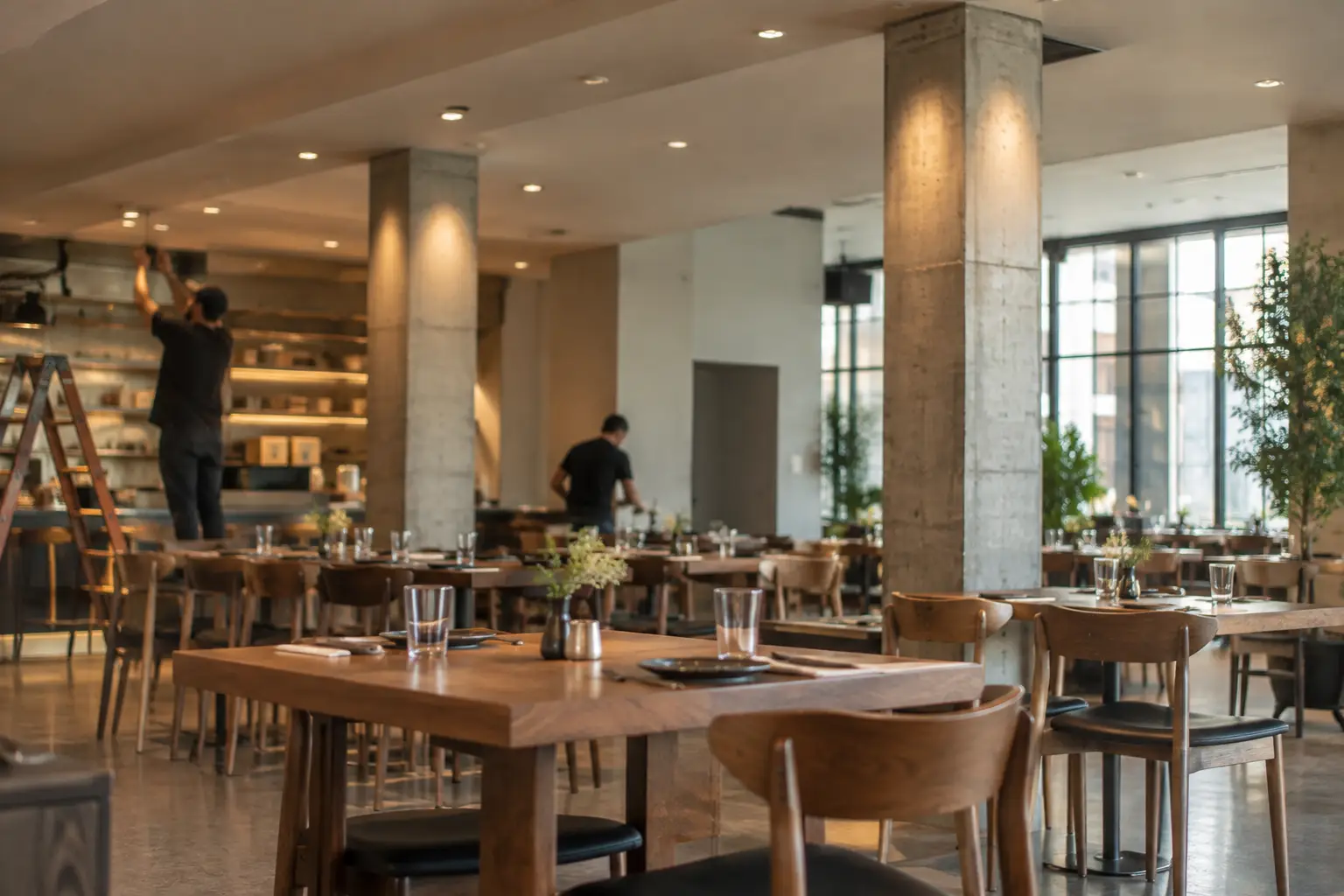
Ordering from unrelated vendors also gives general contractors more problems to sort out. Drivers, the power supplies for LEDs, may conflict, while trim styles may differ and deliveries miss deadlines. Equipment that fails California Energy Commission Title 24 standards can fail inspection, adding costly delays while you arrange another visit.
Standardizing your fixture schedule, the project’s lighting equipment list, through one local LED lighting supplier prevents these mismatches. It keeps LED color batches consistent and voltage tolerances aligned. You also have one source to contact for warranty claims.
Practical check: Mixing driver manufacturers on one dining zone’s dimming circuit causes flicker and abrupt brightness changes below thirty percent output.
Selecting Primary Fixture Types Across Key Restaurant Zones
Each part of a restaurant needs fixtures suited to the work happening there. Before ordering commercial recessed units in volume, check beam angles and trim depth. Check heat ratings too, rather than choosing solely by lumens, the measure of light output.
Video: Restaurant lighting design and layers of light, from Acuity Brands.
Evaluating Commercial Luminaires by Application
Use this comparison as a starting point for choosing fixtures across the restaurant. The checks in the last column matter before you place a large order.
| Fixture Category | Recommended Starting Point | What to Watch |
|---|---|---|
| Deep-Recessed Downlights | 2700K to 3000K, 90+ CRI (color rendering index), 25-degree beam over dining tables ($$) | Check space above the ceiling and the IC rating for insulation contact where blown insulation is present. |
| Recessed Ceiling Flush Disks | Low-profile LED disk units for service corridors and restrooms ($) | Wide beams can shine directly into guests’ eyes when installed above dining seats. |
| Cove Accent Linear Ribbon | 24V high-density LED tape in extruded housing ($$) | Long runs lose voltage; always plan driver locations within fifty feet. |
| Commercial Food Prep Downlights | 4000K, sealed gasket, NSF or wet-rated commercial high-output units ($$$) | Steam and grease can get inside; confirm housings are rated for washdown zones. |
The right LED channels protect fragile tape lights and soften reflections from individual LEDs on polished bars and stone counters. If you plan to buy LED lighting wholesale, settle on matched components for each zone early in framing. That keeps those choices coordinated from the start.
Dialing in Color Quality, Glare Control, and Architectural Mood
Light color needs to stay consistent throughout the room. A warm 2700K baseline suits evening service, but uneven Color Rendering Index (CRI) values can make food look dull. CRI measures how accurately light shows colors. Look for high R9 values, which measure saturated red rendering, so food and wine look natural, as do skin tones.
The kitchen has different moisture and cleaning demands from the bar or outdoor patio. Use these pairings to check what each zone needs before placing your lighting order.
| Hospitality Zone | Recommended Choice | Avoid |
|---|---|---|
| Main Dining Room | Warm-dimming downlights that shift from 3000K to 1800K at minimum output | Fixed 4000K commercial ceiling panels or unshielded surface lights |
| Prep Kitchen & Dish Pit | Sealed, moisture-resistant fixtures; check wet-rated specifications for lasting protection | Standard dry-rated recessed cans that let vapor and grease inside |
| Enclosed Bar Back & Display | Concealed ribbon lights housed in narrow extruded channels | Bare LEDs that reflect dots on mirrored glass backsplashes |
| Covered Outdoor Patio | IP65-rated damp/wet architectural downlights with corrosion-resistant trim rings | Indoor-rated trims that yellow or corrode in marine air |
Installer’s rule: Request LEDs from a single color batch within a 2-step MacAdam ellipse, a tight color tolerance, so five adjacent table spots match.
System Integration: Coordinating Drivers, Dimmers, and Structural Surfaces
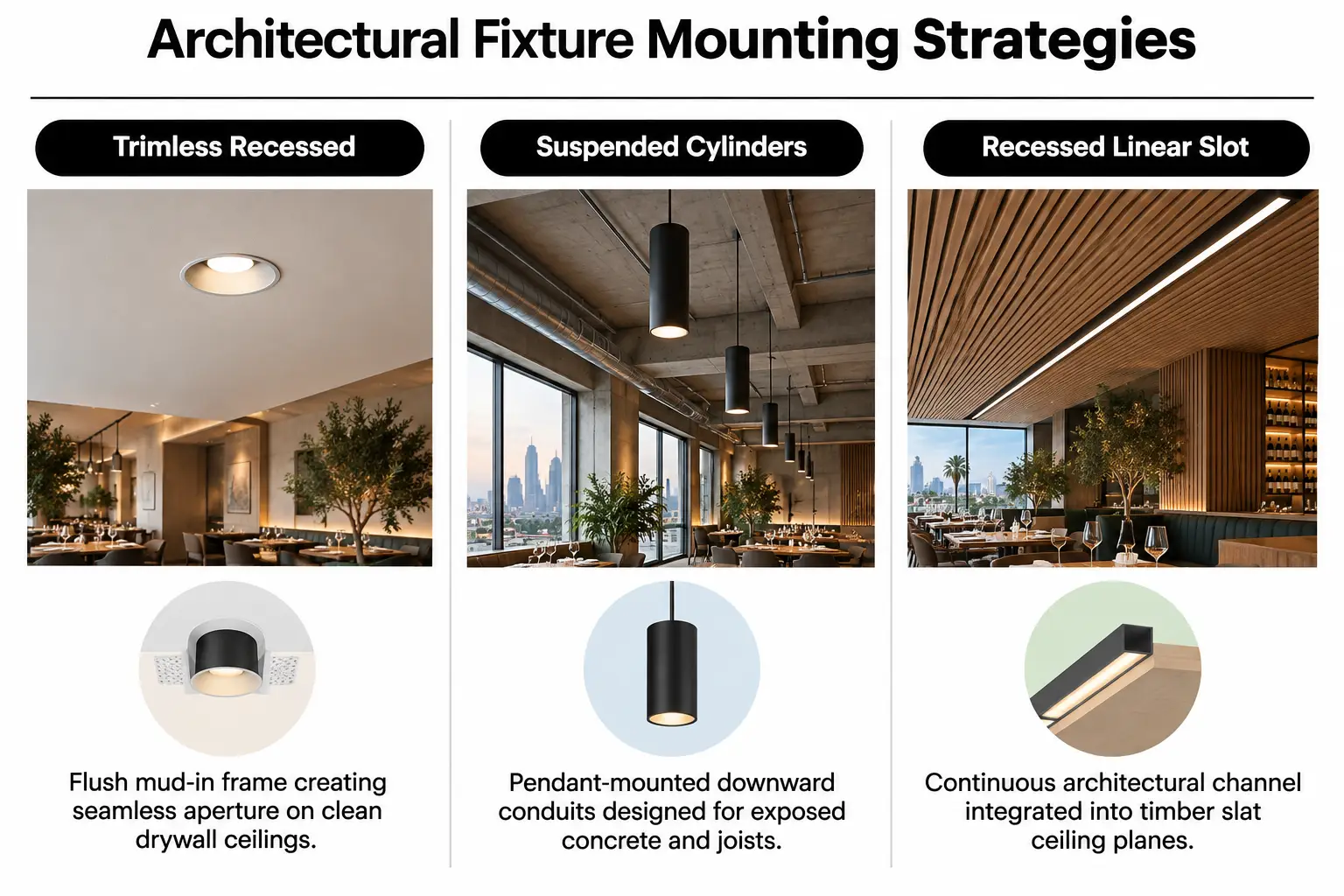
Restaurant ceilings often combine exposed timber and ducts with acoustic plaster or dropped sections. Fixture housings must fit those surfaces, and dimming systems must work with the control panels. Architectural linear lighting, which uses long, narrow fixtures, is worth considering for exposed layouts because its placement shapes sightlines across the room.
| Structural Surface | Pairing Direction | What to Sample or Test | Intended Effect |
|---|---|---|---|
| Drywall / Sheetrock | Trimless recessed downlights finished flush with joint compound | Flange adhesion to joint compound and paint match | Hidden fixture body with a clean light opening |
| Open Joist / Concrete | Surface conduit with suspended architectural cylinders | Suspension cable tension and driver box mounting | Exposed industrial structure with focused pools of light below |
| Wood Slat Ceiling | Narrow linear magnetic tracks fitted between slats | Channel width allowance for wood movement | Continuous ceiling pattern without breaks in its plane |
| Custom Millwork Booths | Undermount tape lights aimed down at kickplates | Diffuser lens density to hide individual LED spots | Low perimeter light with a subtle wash across the floor |
Smooth dimming at low output depends on the driver you choose. Match LED drivers using 0-10V, Phase, or DALI-2, the methods used to control dimming, to your main automation system. That pairing gives you clean fades without buzzing.
A Five-Step Technical Checklist for Commercial Installations
Your electrical contractor needs to coordinate closely with the interior designer and lighting supplier. Follow these steps during rough-in, when wiring and housings go in, and trim-out, when fixtures get their final fittings:
- Calculate exact table grid coordinates: Confirm the furniture layout before drilling openings or framing rough-in boxes. Downlight beams should land on tables, not the main paths guests use.
- Verify plenum and conduit clearances: Check the space above the ceiling for ductwork and fire sprinkler pipes. Kitchen exhaust hoods must also clear recessed housings and linear driver enclosures.
- Mount remote driver enclosures in accessible closets: Put secondary power supplies where technicians can reach them without cutting drywall. Repairs should not disturb seated guests during service.
- Set multi-zone dimming scenes: Program separate presets for lunch, the golden hour transition, dinner turnover, and late-night bar service. These keep the atmosphere consistent as service changes.
- Verify life safety compliance: Use architectural battery packs or dedicated units, such as an indoor rectangular LED emergency light. These must meet exit-route lighting codes while fitting the room’s design.
Before you buy: Test your exact dimmer, driver, and downlight together on spare drywall, and check for high-pitched coil noise while the light is dimmed.
Capital Allocation: Where Hospitality Specifiers Spend and Save
Keeping commercial LED lighting affordable means deciding where better light will make the most difference. Spending too much on hidden back-of-house fixtures leaves less for the dining areas guests actually see.
| Budget Level | What to Prioritise | What to Question |
|---|---|---|
| Baseline ($) | Standard commercial flat panels and vapor-proof strips in dry storage and dishwashing areas | Premium-brand architectural housings in private offices or employee breakrooms |
| Mid-Range ($$) | High-CRI dining downlights with interchangeable optics and deep shields to reduce glare | Costly decorative pendants that put little useful light on tables |
| Premium ($$$) | Warm-dimming modules and continuous linear fixtures finished into drywall, with multi-scene controls | Proprietary wireless fixtures with closed controls that tie replacement parts to one source |
Optical accessories can make a visible difference without a large budget increase. Hex-cell louvers, which shield the light source, and solite softening lenses soften shadows on table settings. They also keep seated guests from seeing the bright source directly, making the room more comfortable.
Common Questions on Commercial Hospitality Illumination
What is the best color temperature for an upscale modern restaurant?
Warm white light between 2400K and 2700K is the most flattering choice for evening dining. Warm-dim LED modules work especially well because their color shifts toward 1800K as you lower the output. That gives you the familiar amber glow of traditional incandescent filament lighting.
How do restaurants meet California Title 24 lighting regulations?
Compliance requires automated multi-scene dimming and daylight sensors where windows are present, so electric light adjusts to available daylight. It also requires energy-efficient LED fixtures certified under JA8 criteria. An experienced regional distributor makes sure the submitted specification sheets meet plan-check requirements before electrical rough-in starts.
Why is high CRI critical above commercial dining tables?
Choose a Color Rendering Index of at least 90 with an R9 rating above 50. That combination shows food and garnishes accurately and keeps cocktails looking appetizing. Low-CRI LEDs wash out reds and earthy colors, so fresh ingredients can look gray or unappealing under direct light.
What beam spread should I specify for table downlighting?
Narrow flood beams between 24 and 35 degrees put focused light on tables while leaving aisles in softer shadow. Wide 60-degree beams often spill glare into the edges of guests’ vision. That spill can make a dining room feel more like an uncomfortable cafeteria.
How does working with an LED lighting wholesaler benefit contractors?
A wholesale specialist offers volume pricing and checks that components work together, with deliveries coordinated for the job site. Keeping orders together eliminates supply delays and driver-dimmer conflicts. Developers also get dedicated technical support through commissioning, the final process of testing and setting up the system.
Planning Your Fixture Schedule with Raycos Lighting
At Raycos Lighting, we supply commercial lighting and LED equipment for hospitality projects, retail spaces, and corporate build-outs across Los Angeles, California. We keep a broad inventory of architectural linear channels and commercial recessed cans, alongside durable drivers and code-compliant fixtures. Contractors can source these together rather than manage separate vendor orders.
Before you finalize the dining room’s fixture schedule, check these items against your plans and equipment specifications:
- Confirm Title 24 compliance and JA8 documentation for every dining room fixture.
- Match driver dimming ranges (0-10V or Phase) to the control stations you plan to use.
- Specify deeply recessed trims with 90+ CRI throughout guest-facing areas.
- Check clearance above the ceiling against all HVAC and fire protection runs.
- Choose simple architectural fixtures, such as a white 5 edgeless LED downlight, for minimalist plaster ceilings.
Contact our team at Raycos Lighting to review architectural specification sheets and put together a quote for your hospitality project.