

Modern LED ceiling lights improve commercial property value and tenant retention in Los Angeles by lowering operating costs. Upgraded fixtures help buildings meet California energy standards. Better lighting also makes the space more appealing to commercial tenants.
How you buy those fixtures matters. Retail prices eat into your improvement budget before installation starts. Mismatched light colors or poor-quality drivers, the components that power LEDs, can leave you with maintenance costs that cut into rental income.
What’s Inside This Guide
- The Real Cost of Antiquated Fixtures in LA Real Estate
- Selecting the Right Commercial Fixture Architectures
- Matching Fixture Output to Your Specific Property Profile
- Hardware Integration, Switching, and Dimming Protocols
- The Commercial Procurement and Installation Pathway
- Capital Expenditure Allocation: Where Every Dollar Works Hardest
- Common Appraisals and Spec Questions
- Pre-Procurement Checklist for Commercial Buyers
The Real Cost of Antiquated Fixtures in LA Real Estate
Commercial appraisals depend heavily on cash flow. Buyers looking at an older office or industrial building see outdated fluorescent ceiling fixtures and metal halide high bays as costs. They account for both the work needed to replace them and the power those fixtures use until then.
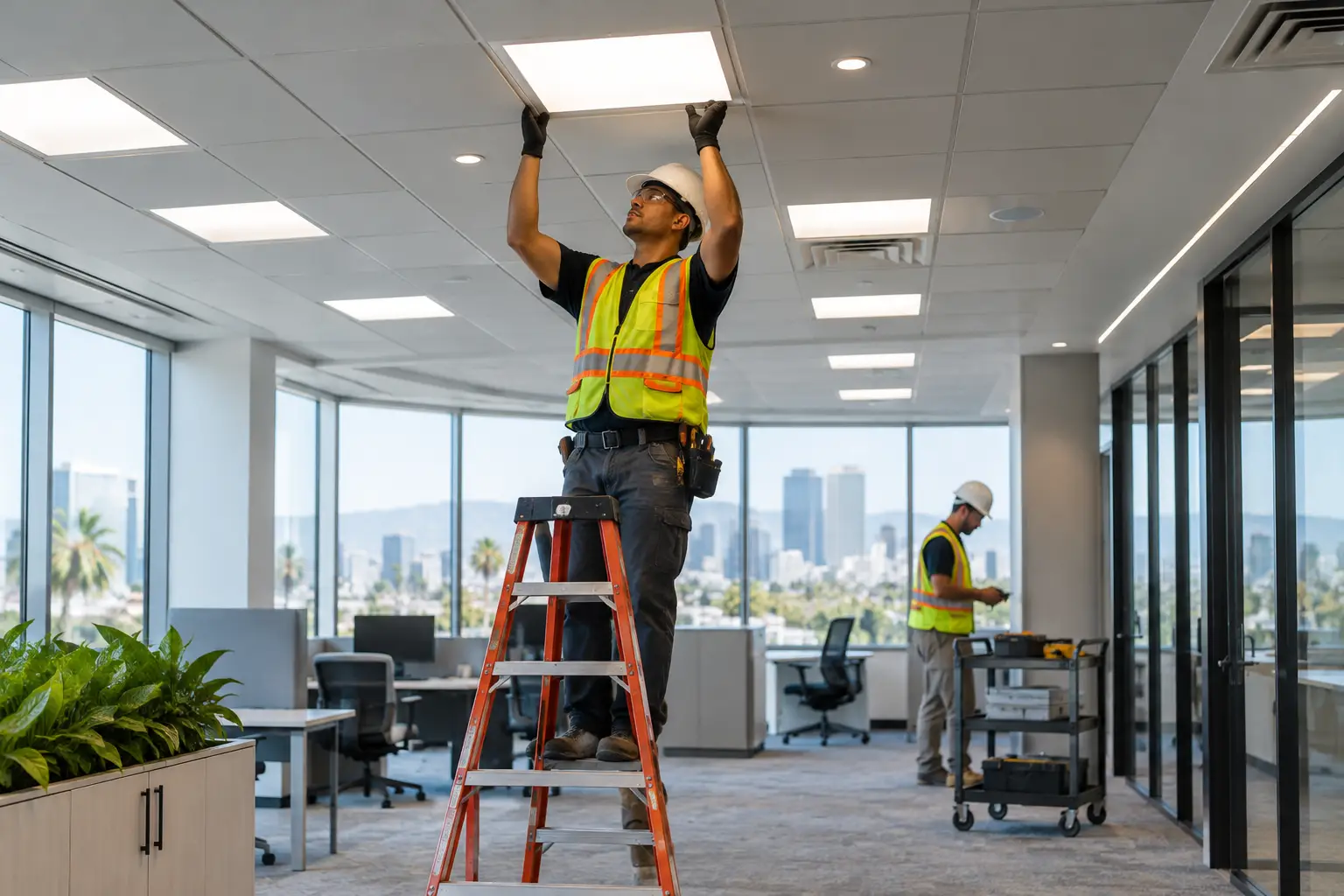
Southern California commercial electricity rates, including those from the local power utility, sit well above the national median. That makes inefficient lighting a cost buyers account for when valuing a property.
California Title 24 lighting standards also apply to commercial upgrades. They limit lighting power per square foot and require automatic shutoff controls. Fixtures that do not meet the requirements can cause problems during permitting or resale inspections, even if they look right for the space.
Poor lighting can hurt leasing rates, too. Dim, yellowing light suggests the building has not been maintained. Check your existing fixtures before deciding between full replacement and a targeted upgrade. Our guide to buying recessed lights wholesale or retail covers that purchasing decision.
Appraisal rule: Lasting reductions in building overhead raise net operating income, the income left after operating costs, which increases income-based property value.
Selecting the Right Commercial Fixture Architectures
Developers and electricians need different fixture styles without having to coordinate orders across several distributors. A lobby needs a different layout from a warehouse bay or retail showroom. Choosing that layout early helps you meet code while keeping the lighting consistent with the building’s design.
Evaluating Fixture Layouts and Structural Requirements
Ceiling construction determines how fixtures mount and how they release heat. At Raycos Lighting, our catalog lets you source components together. That helps you match drivers and trim sizes across a floor, while keeping the way colors appear under the lights consistent.
| Fixture option | Recommended starting point | What to watch |
|---|---|---|
| Canless architectural downlights | Shallow ceiling cavities, multi-family corridors, residential mixed-use | Check driver clearance and the IC rating, which permits contact with insulation |
| Modular grid flat panels & troffers | Standard drop-ceiling offices and clinical spaces | Confirm compatibility with 0-10V controls, which use a low-voltage dimming signal |
| Suspended linear systems | Open industrial ceilings, creative workspaces, studios | Use rigid suspension hardware and joints that keep sections straight |
| High-output industrial high bays | Warehouses, manufacturing plants, logistics hubs | Check how light output declines over time and the allowed operating temperature |
Reliable recessed housings can be hard to source in large quantities when a project is moving quickly. Our walkthrough on sourcing bulk recessed lights for California projects explains how to line up certified fixtures before framing finishes. Sorting out supply early helps electricians keep the installation on schedule.
Matching Fixture Output to Your Specific Property Profile
Boardrooms and aerospace logistics depots need very different lighting. Poor light can reduce productivity and discourage customers from spending time in a commercial space. Busy properties need durable, flicker-free drivers and a high color rendering index (CRI), which measures how accurately colors appear compared with daylight.
Contractors updating older Los Angeles buildings often choose architectural ceiling lights to help retain tenants. Match lumens, the measure of total light output, to fixture spacing. More light is not always better: the layout needs to avoid dark patches without creating harsh glare.
| Property space | Recommended choice | Avoid |
|---|---|---|
| Creative office / agency space | Continuous linear fixtures with trimless downlights, 3500K or 4000K color temperature | Bare 5000K drop-ceiling troffers that create glare on monitors |
| High-end retail showrooms | High-CRI (90+) directional downlights and magnetic accent tracks | Fixed broad-flood diffusers that do not focus enough light on displays |
| Multi-family residential portfolios | Deep recessed trims that shield the light source, wet-rated shower units, 2700K or 3000K | Shallow surface-mounted puck lights with visible LED dots |
| Fulfillment & storage centers | Focused LED high bays with built-in occupancy sensors | Lights that stay on continuously without sensors |
Luxury multi-family buildings and corporate properties often need more specialized hardware than a basic ceiling fixture provides. Our guide to dimmable recessed lights for Los Angeles residences covers premium options. Use it to compare components before settling on the fixtures for those spaces.
Purchasing check: Fixtures rated 90+ CRI show finishes and materials more accurately in common areas, helping tenants see their value during lease walkthroughs.
Hardware Integration, Switching, and Dimming Protocols
Fixtures have to work with the rest of the lighting system. Check the drivers against the site controls, along with the connectors used for linear runs. Mismatched parts can cause humming or flicker. Dimming faults also frustrate tenants and send electricians back to fix problems after installation.
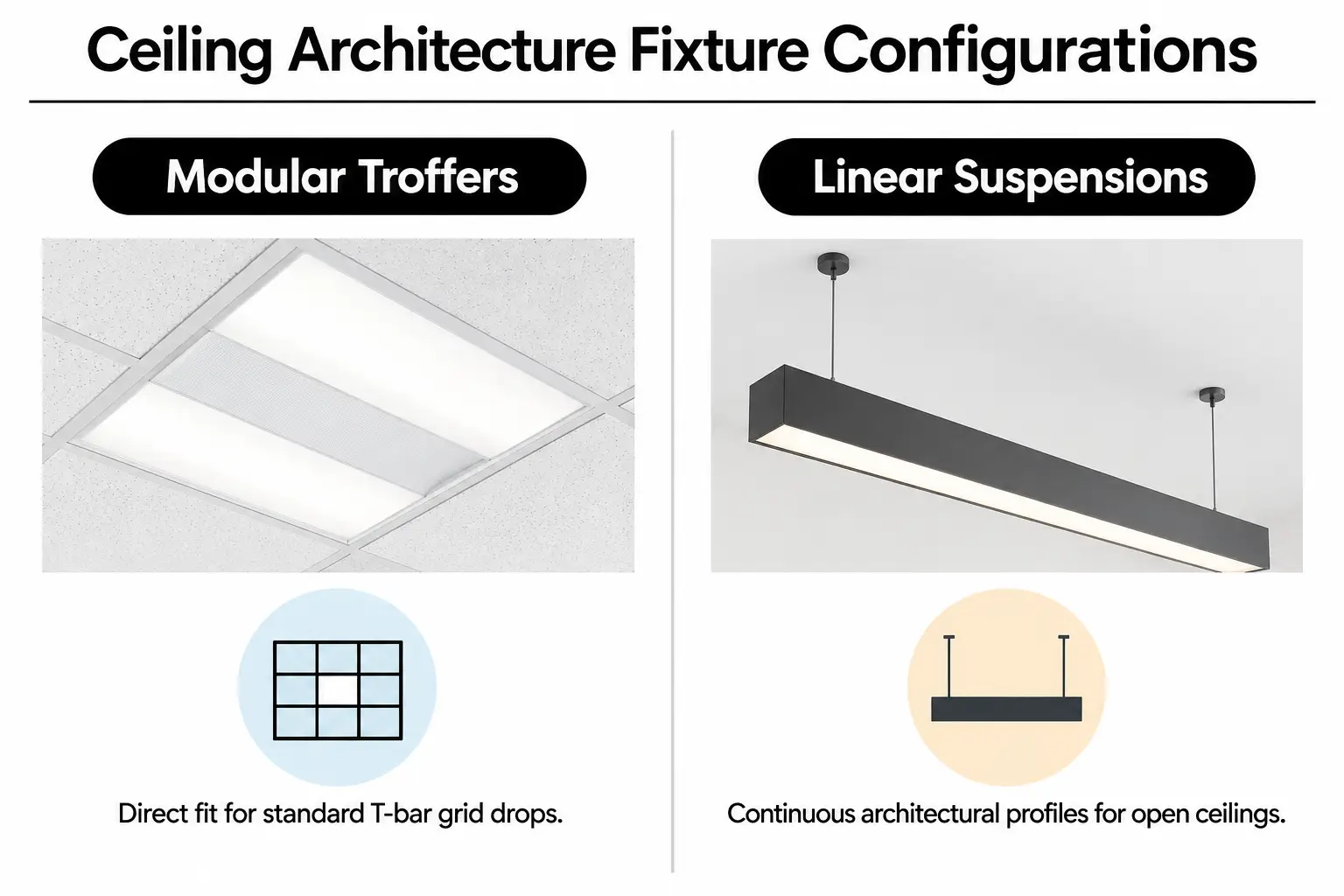
Open layouts with suspended LED runs need connectors designed to keep the sections straight and carry power through them. A 90-degree ceiling-to-ceiling connector keeps corners neat. A dedicated ceiling-to-wall connector lets the same profile continue down a wall without exposed wiring.
| Starting point | What to pair it with | What to sample or test | Intended effect |
|---|---|---|---|
| 0-10V commercial drivers | Photocells that adjust output to daylight, paired with wall controls | Smooth fading to off without abrupt cutoffs | Code-compliant daylight zones with unobtrusive automatic dimming |
| Continuous suspended runs | Connected linear channels using an 8ft LED strip light | Lens alignment from end to end and light leaking through joints | Unbroken lines of light that emphasize ceiling height |
| Closely spaced downlights | Recessed multi-cell trims that shield the light sources | Unified glare rating (UGR), a measure of discomfort from glare, at typical desk positions | Even light with little glare from fixtures |
| Commercial retail displays | Magnetic track runs with adjustable accent heads | Power delivery through the track with the full circuit loaded | Accent lighting that can move as merchandise changes |
Property managers renovating busy buildings also need to account for how people use each space throughout the day. We cover those demands in our guide to LED ceiling lights for busy LA retail spaces, with a focus on choosing fixtures for commercial foot traffic.
The Commercial Procurement and Installation Pathway
A clear supply plan helps developers and electrical contractors avoid retail markups and split shipments. Getting materials to the site in the right order keeps labor costs down. It also prevents crews from waiting on missing parts while other work moves ahead.
Video: Installing the 48-in white LED 5CCT flat panel ceiling light, model FP1247-AL5-48LFC (Good Earth Lighting)
- Review the lighting layout: Map floor area and working heights against Illuminating Engineering Society recommendations. Use those measurements to choose beam spreads and the number of fixtures.
- Check code compliance: Confirm the specified fixtures have the safety listings your local building department requires, such as UL or ETL. Check the applicable efficiency requirements before ordering.
- Source components together: Buy downlights and linear runs through the same commercial vendor as your warehouse fixtures. Combined quantities help secure bulk pricing and avoid separate freight charges.
- Test sample units on-site: Connect fixture samples to the specified 0-10V or digital dimmers. Confirm that they dim smoothly before committing to the full project order.
- Schedule deliveries in phases: Match deliveries to framing and rough-in progress, when wiring and other services go in. This keeps delicate fixtures off busy floors until they are needed.
Our team can help you check fixture specifications before you place a large commercial order. Working through those details with an experienced supplier helps keep installation on schedule. Contact our technical lighting team while you are reviewing the specifications.
On-site testing rule: Test one driver and dimmer combination through its full dimming range on-site before ordering enough for the whole project.
Capital Expenditure Allocation: Where Every Dollar Works Hardest
Spend your improvement budget on components that add lasting value, rather than quick cosmetic fixes. Buying ceiling fixtures wholesale lowers upfront purchasing costs. That leaves more room for better components in the spaces where tenants and visitors will notice the difference.
| Budget level | What to prioritize | What to question |
|---|---|---|
| Value tier ($) | Standard troffers and basic canless downlights rated for insulation contact | Unknown overseas drivers with high total harmonic distortion (THD), which distorts electrical current |
| Performance tier ($$) | Architectural fixtures with selectable color temperature and wattage, plus 90+ CRI ratings | Complex custom profiles where standard fixtures fit the space |
| Architectural tier ($$$) | Continuous trimless linear fixtures finished into drywall, magnetic track systems | Closed control systems that cannot work with third-party sensors |
Put reliable drivers first. Choose a high power factor, which means the driver uses the electrical supply efficiently, because driver failure leads commercial maintenance problems. Architectural features make sense in main lobbies and conference rooms. Simple utility fixtures are enough for back-of-house storage areas.
Supplier checks deserve the same care as fixture selection. They help protect both your schedule and your budget before money is committed. Our guide to vetting a wholesale LED supplier explains how to review suppliers for your next project.
Common Appraisals and Spec Questions
Do LED lighting retrofits directly increase a commercial property appraisal?
Yes. Commercial appraisals use net operating income to calculate property value. LED retrofits reduce lighting energy use and routine maintenance costs, lowering the building’s overhead. Those ongoing savings raise the property’s value under an income-based appraisal.
How does California Title 24 compliance affect property resale?
Lighting installed without permits or outside code requirements often comes up during a buyer’s inspections. Owners may have to accept price concessions or arrange urgent replacements before closing. Compliant Title 24 installations help protect the asking price and avoid those delays during a sale.
Why is wholesale buying better for commercial margins than trade supply desks?
Local trade supply counters typically add a retail markup to lighting products. Buying directly through volume distributors such as Raycos Lighting removes that retail layer. We also give you one point of contact for project submittals, the product documents sent for approval.
What color temperature best suits commercial properties in Los Angeles?
Most offices suit 3500K to 4000K light, which supports focus without looking too clinical. Multi-family living spaces generally call for warmer 2700K to 3000K tones. Light industrial spaces benefit from 4000K or 5000K light. The K stands for kelvin, the scale used to describe light color.
Can updating drop-ceiling troffers be completed without replacing existing ceiling grids?
Existing standard 2×2 and 2×4 T-bar ceiling grids accept efficient LED flat panels and troffer retrofit kits directly. That lets crews upgrade lighting in occupied tenant spaces without replacing the grid. Structural framing and existing wiring can stay in place during this type of upgrade.
Pre-Procurement Checklist for Commercial Buyers
Before buying fixtures for a commercial upgrade, check the building requirements against your order. The purchase needs to reduce energy use while meeting local code. Tenant comfort matters, too, especially in spaces you want to lease for the long term. Use these checks before placing the order:
- Verify compliance documents: Check Title 24 requirements and confirm the required UL or ETL safety listings for each fixture.
- Confirm ceiling cavity depths: Measure clearance around overhead mechanical equipment before ordering recessed housings.
- Double-check control compatibility: Match each driver’s dimming method, 0-10V or phase dimming, to the switches installed on-site.
- Calculate the load reduction: Record the expected power savings for municipal and utility energy rebate claims.
- Secure combined bulk pricing: Order the full fixture schedule together to reduce freight charges and split deliveries.
Send our Raycos Lighting team your fixture quantities and schedule so we can review specification alternatives and quote volume wholesale pricing.