

Yes, you can use different LED color temperatures in one room. Keep each correlated color temperature (CCT) in its own functional layer or clearly defined zone.
As an LED and lighting wholesaler, we see better results when general room lighting stays uniform. Task areas and displays can then use a different Kelvin rating. Scatter warm and cool fixtures across the same ceiling, though, and the patchy light can hurt concentration and make the room look poorly planned.
Across California, designers use warm and cool light together in commercial spaces, multi-family common areas, and custom offices. General lighting helps people move around comfortably and safely. More focused task light draws attention to workspaces or products. Getting that balance right takes care with fixture placement and controls, along with consistent sourcing.
What’s Inside This Guide
- The Anatomy of Color Temperature: Defining Kelvin and Fixture Roles
- Layering Light Without Clutter: A Step-by-Step Approach
- Zoned Color Mixing vs Single-CCT Uniformity and Tunable Systems
- Practical Kelvin Pairings for Commercial and Mixed-Use Spaces
- Application Suitability: Where Mixing Works and Where It Fails
- Long-Term Color Consistency: Managing Binning and LED Aging
- Frequently Raised Questions on Mixing Kelvin Ratings
- Sourcing Matched LED Systems with Raycos Lighting
The Anatomy of Color Temperature: Defining Kelvin and Fixture Roles
Color temperature describes how warm or cool white light looks, measured in Kelvin (K). A lower rating, such as 2700K, gives a soft amber glow like an incandescent lamp. Ratings of 4000K or 5000K give cooler, daylight-like light. For commercial buildouts, assign each fixture a clear job so the different tones don’t compete.
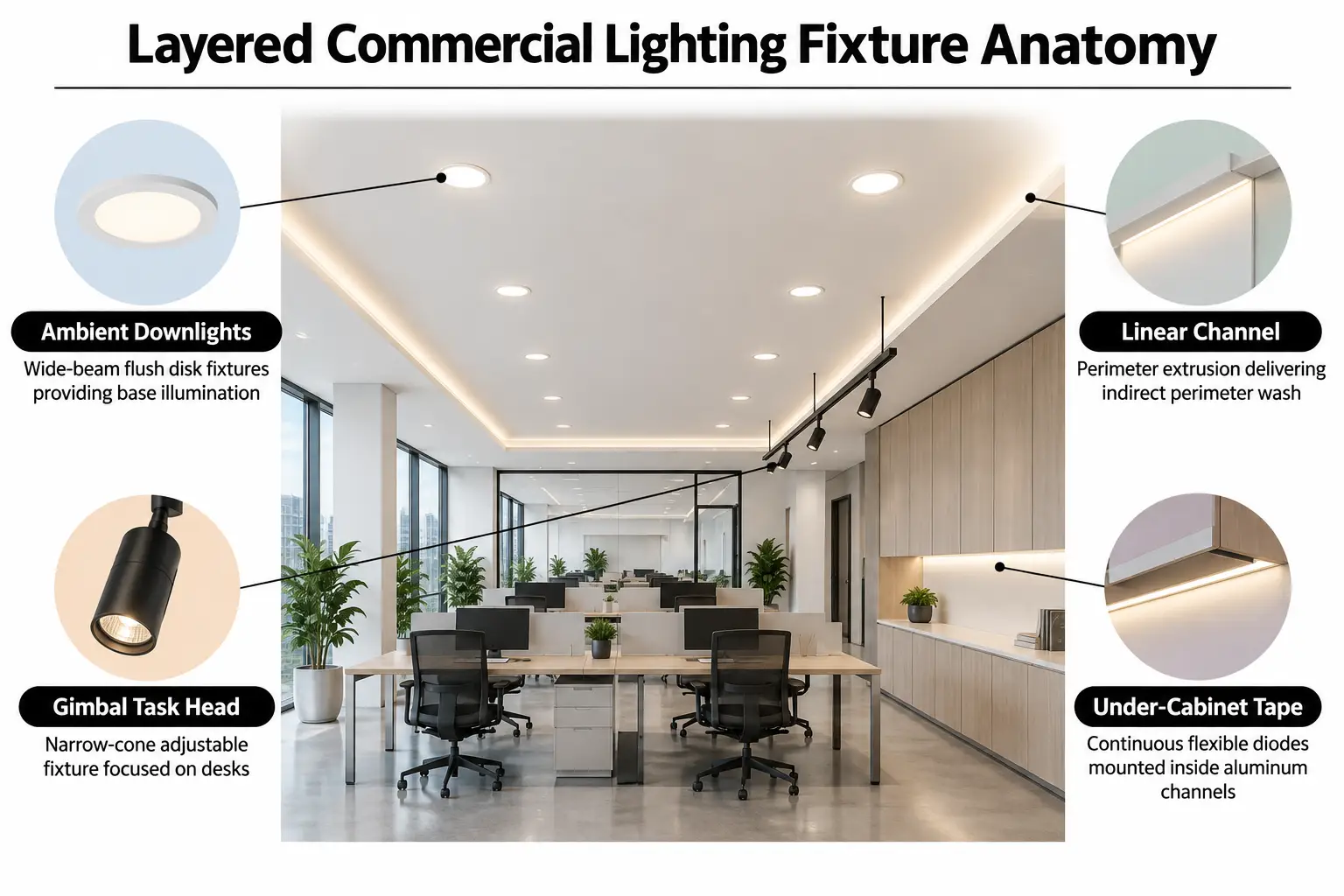
- Ambient ceiling fixtures: Surface troffers, panels, or a low-profile LED disk provide the basic light level along walking routes, measured in foot-candles.
- Architectural linear channels: Rigid aluminum LED channels hold tape lights that wash perimeter walls or highlight built-in woodwork.
- Directional task fixtures: Adjustable spots or a recessed 3-inch, 9W selectable-CCT gimbal trim aim light directly at work surfaces.
- Linear accent tapes: Continuous runs of LED tape sit beneath cabinets or inside ceiling coves to give the room depth.
For wholesale LED orders covering several rooms, matching drivers and diffusers matters just as much as choosing Kelvin ratings. Drivers supply power, while diffusers spread the light. Poorly matched diffusers can make identical LED diodes look different in color.
Layering Light Without Clutter: A Step-by-Step Approach
Start with how people will use the room. An executive boardroom or restaurant dining room usually calls for a comfortable ambient base around 2700K to 3000K. An open office or light assembly floor needs clearer working light, so start the general lighting at 3500K or 4000K.
Video: How to Light a Small Room: Lumens, Color Temperature, and Layers (The Decor Brief)
Next, reserve the second color temperature for task lighting or perimeter accents. Mount 4000K fixtures above conference tables or drafting counters, for example, with 3000K light on perimeter walls. Aim beams at work surfaces without overlap in mid-air. Follow Illuminating Engineering Society standards for luminance ratios, which compare the brightness of neighboring surfaces.
The Switching Mistake Most Contractors Overlook
Putting warm and cool fixtures on the same circuit can spoil an otherwise good plan. One switch bringing on 3000K downlights and 5000K troffers overhead makes the ceiling look miswired. Give each CCT layer its own 0-10V dimming channel, which uses a voltage signal to adjust brightness, or a controller that addresses each lighting scene separately.
Occupants can then dim the general lighting without losing bright light at their desks.
Zoned Color Mixing vs Single-CCT Uniformity and Tunable Systems
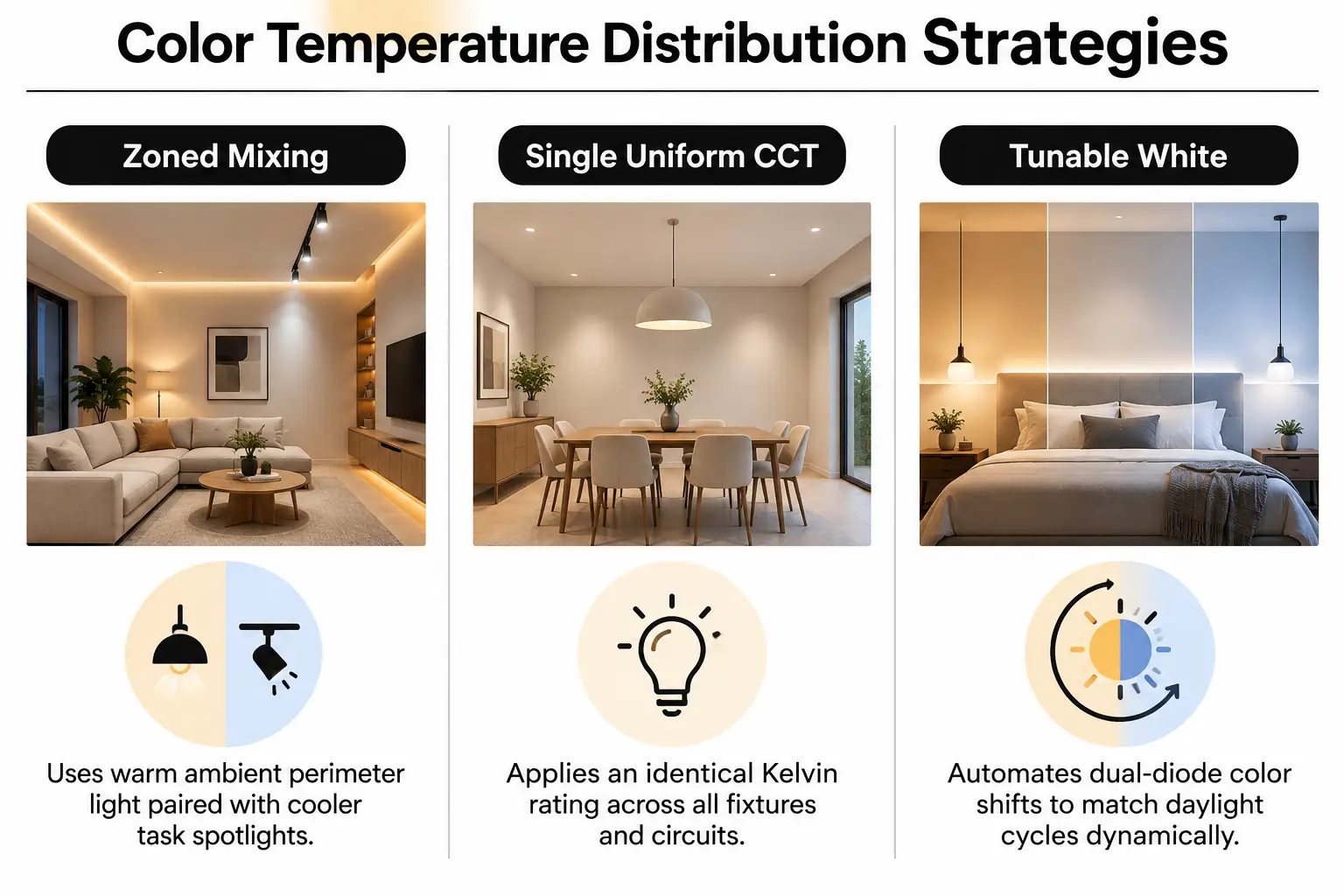
Before ordering, compare fixed color zones with a single-temperature layout or a tunable white system that changes color temperature.
| Design approach | Visual result | Wiring effort | Hardware cost tier | Best application |
|---|---|---|---|---|
| Fixed color zones | Separate lighting layers with focused task light | Moderate (needs separate switched wiring) | $$ | Offices, retail stores, open-concept restaurants |
| One color temperature throughout | Even light with no color changes across the room | Low (standard shared switching) | $ | Warehouses, corridors, standard utility rooms |
| Tunable white smart systems | Color shifts that follow daily daylight patterns | High (needs a data bus or DMX control wiring) | $$$ | High-end corporate headquarters, healthcare suites |
A local LED lighting supplier can help contractors mock up fixture pairings before rough-in, when wiring goes into the walls. That gives you a chance to check how the lights look together on site.
Practical Kelvin Pairings for Commercial and Mixed-Use Spaces
Keep the difference between temperatures deliberate rather than picking ratings at random. These are three reliable pairings lighting professionals use for common commercial layouts:
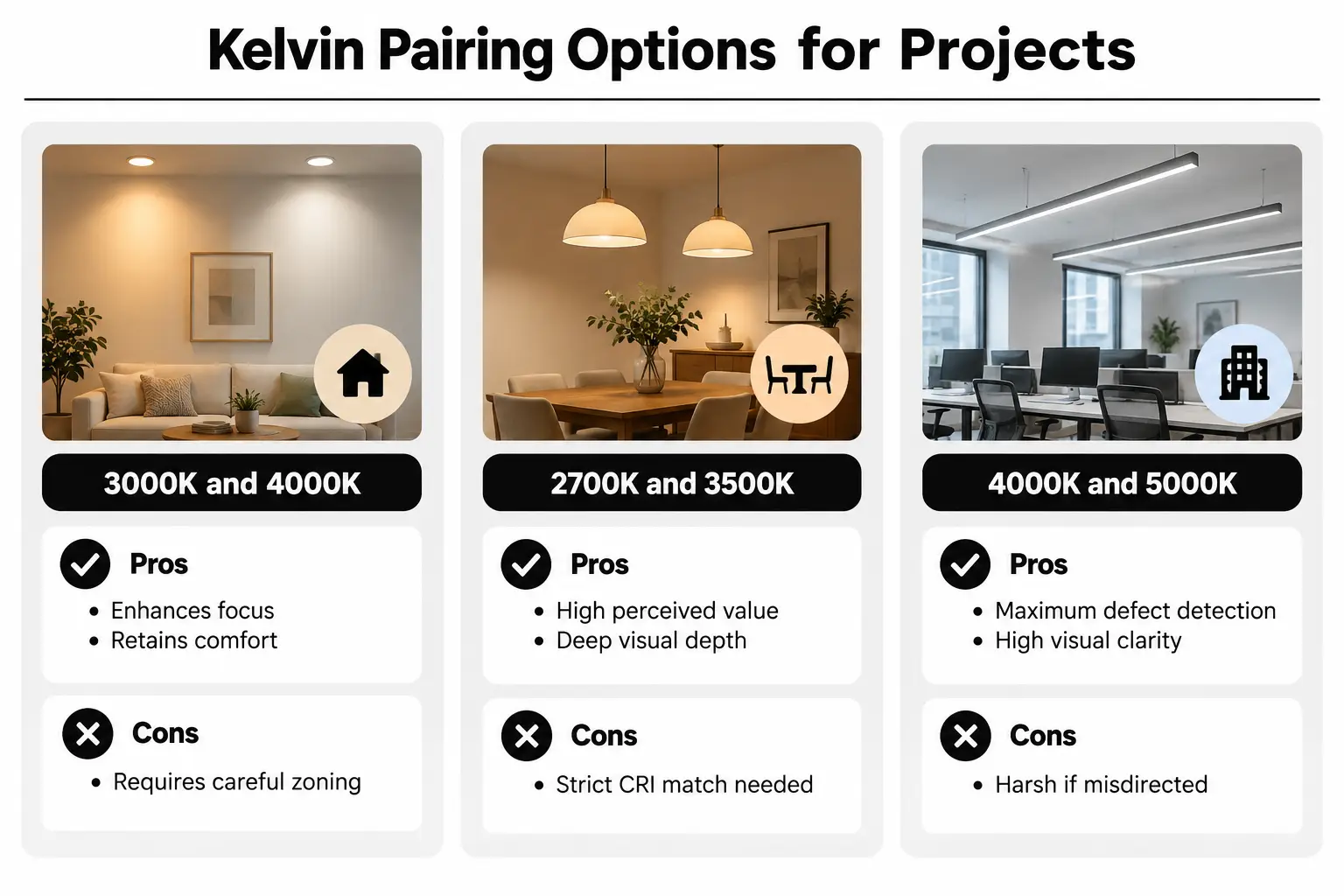
- 3000K ambient with 4000K task: A good fit for creative workspaces and boutique retail. The 3000K base feels warm, while 4000K task fixtures light paperwork and product packaging clearly. Pro: Supports focus without making the room feel clinical. Con: Needs careful aiming so both colors don’t spill onto the same walls.
- 2700K decorative with 3500K architectural wash: Common in hospitality and residential high-rises. Sconces and pendants give a warm 2700K glow, while ceiling troughs light room edges at a neutral 3500K. Pro: Strong contrast gives an upscale feel. Con: Leaves little room for error; poor-quality diodes quickly look mismatched.
- 4000K general area with 5000K inspection: Often used in technical production areas. Walking aisles stay at 4000K, while quality control desks get 5000K fixtures. Our guide to industrial fixtures for demanding warehouses covers specialized options. Pro: Makes defects easier to spot while keeping walking routes comfortable. Con: 5000K can feel harsh if the beam spills beyond the workbench.
Application Suitability: Where Mixing Works and Where It Fails
Some rooms have enough space and distinct uses to support different color temperatures. Others simply look better with one consistent tone.
| Space type | Recommended approach | Primary risk | Installation rule |
|---|---|---|---|
| Open office layouts | 3500K ambient with 4000K desk task lighting | Glare reflected on computer screens | Aim task beams downward, below eye level |
| Industrial assembly floors | 4000K linear runs with 5000K focused task bars | Eye strain from looking quickly between zones | Keep brightness ratios within 3:1 between zones |
| High-end residential great rooms | 2700K cove accents with 3000K downlights | Muddy amber shadows on neutral walls | Give every lighting layer its own dimmer |
| Compact restrooms or hallways | One CCT only (3000K or 3500K throughout) | A patchy, mismatched appearance | Avoid mixing CCTs in rooms under 150 square feet |
Installer’s rule: Don’t put different color temperatures side by side in identical housings within one ceiling grid. Fixtures with matching trim must have matching CCTs.
California installations must meet strict efficiency requirements too. Check the state’s building energy efficiency standards so your controls and multi-channel dimmers meet the rules for final electrical inspection without delays.
Long-Term Color Consistency: Managing Binning and LED Aging
Good color matching on installation day won’t last without quality hardware. Lower-grade LEDs age unevenly, and their color can drift over thousands of hours of use.
Routine Quality and Specification Audits
- Verify MacAdam ellipse ratings: Specify commercial fixtures within 3-step MacAdam ellipses, a measure of color variation. This tight color grouping keeps output uniform from the start.
- Inspect dedicated power units: Pair tape runs with certified LED drivers that supply steady current. This protects the diodes’ light-converting phosphor coating from breaking down early.
- Standardize trim selections: For compact ceilings, match fixture opening sizes with options like a 2-inch smooth square LED trim. Consistent trim keeps the ceiling looking orderly despite different CCT settings.
Property managers buying bulk LED lighting for several floors need color consistency across the order. We recommend working with a supplier that tracks production batches, rather than relying on the Kelvin rating alone.
Frequently Raised Questions on Mixing Kelvin Ratings
Will mixing 3000K and 4000K LEDs make a room look uncoordinated?
Randomly placing identical fixtures with different temperatures across one ceiling makes the room look uncoordinated. Keep 3000K around the perimeter for general light, with 4000K aimed down at desks or islands. Your eye then reads the contrast as depth rather than a mistake.
Does mixing color temperatures complicate California Title 24 compliance?
No, Title 24 checks connected wattage and lighting power density (LPD), meaning power used per unit of floor area. It also covers automated controls, rather than specific Kelvin choices. Since mixed-CCT spaces need separate switching circuits, check that multi-zone controls meet the required occupancy-sensor and dimming rules.
Our review of whether Los Angeles businesses should switch entirely to LED lighting in 2025 covers more regional commercial upgrades.
Does Color Rendering Index matter when mixing color temperatures?
Yes, match the Color Rendering Index (CRI), which measures how faithfully light shows colors. Pairing 90 CRI ambient light at 3000K with 80 CRI task light at 4000K makes fabrics and wood tones look dull under the cooler fixtures. Keep the whole project at 90 CRI or above.
Can I mix color temperatures using selectable CCT downlights?
Field-selectable downlights let installers choose 3000K, 3500K, or 4000K on each fixture during final trim installation. That makes them practical for contractors working with different lighting zones. Label the circuit schedules clearly so anyone replacing a fixture years later knows the exact switch setting to use.
Does running different Kelvin ratings affect overall power consumption?
Color temperature has very little effect on power use. The U.S. Department of Energy explains that fixture efficacy, or light output per watt, depends on diode design and driver efficiency. How the fixture spreads light also matters more than its Kelvin rating.
Sourcing Matched LED Systems with Raycos Lighting
Mixed-temperature plans need dependable stock and careful color matching, backed by people who know the products. At Raycos Lighting, we’re a full-service LED and lighting wholesaler supplying high-quality lighting equipment to developers across California. We serve commercial and industrial projects as well as residential developments.
We keep architectural linear profiles and selectable downlights in warehouse stock, along with industrial bays, to help keep projects on schedule.
Before buying fixtures for your next project, check these details against your plans:
- Show separate ambient and task circuits on the rough-in electrical drawings.
- Specify 90+ CRI for every warm and cool fixture on the schedule.
- Require 3-step MacAdam ellipse color grouping to avoid visible differences between diodes.
- Check that every driver supports the dimming method used in its control zone.
- Review layout options in our guide to architectural linear lighting and where to use it.
Send your project specifications to our commercial sales team for a custom quote or help with the layout.