

To estimate your LED upgrade’s return, compare the full project cost with yearly energy and maintenance savings. At Raycos Lighting, we help you weigh fixture pricing against commercial utility rates and local building requirements. A local LED lighting wholesaler should help you work through those costs before you order.
Buying through an established distributor gives contractors and property managers access to volume pricing. Specification support also helps you choose the right hardware without stretching the capital budget.
The most common mistake on Los Angeles retrofit jobs is using residential electricity averages instead of actual commercial peak-demand rates. Commercial buildings often pay steep demand surcharges during afternoon cooling peaks. Efficient fixtures with dedicated controls reduce those peaks, bringing payback months ahead of standard spreadsheet estimates.
What’s Inside This Guide
- Core Performance Metrics That Determine Financial Returns
- Fixture Categories and Hardware Configurations for Commercial Retrofits
- Calculating Fixture Counts and Lumen Distribution for Maximum Efficiency
- Navigating Title 24 Mandates and Los Angeles Permitting Standards
- Accounting for Maintenance Cycles, Operating Hours, and True Payback
- Procurement Audit Checklist Before Placing Commercial Orders
- Practical Answers on Commercial LED Payback in Los Angeles
- Partnering with Raycos Lighting on Your Next Capital Upgrade
Core Performance Metrics That Determine Financial Returns
Your building’s daily use determines which fixtures will pay for themselves fastest. Start with how each space operates, rather than just counting lamp sockets. During the first audit, check these four factors before comparing hardware prices:

- Daily operating hours: Buildings running 16 to 24 hours daily recover their upfront costs in a fraction of the time needed by single-shift spaces.
- Utility rates: Los Angeles Department of Water and Power (LADWP) customers face specific rate tiers and peak-demand surcharges. Reducing electricity use at peak times makes those savings more valuable.
- Maintenance access: Industrial ceilings often require scissor lifts and certified operators. That turns a simple lamp replacement into a substantial operating expense.
- Heat exposure: Surrounding heat wears out drivers, the components that regulate power to LEDs. Heavy-duty heat sinks carry heat away and help prevent early equipment failure.
Checking these demands first keeps you from buying hardware that cannot handle the job. For a building with high commercial energy bills, match fixture performance to the utility’s rate schedule. That is the most reliable way to recover your investment quickly.
Fixture Categories and Hardware Configurations for Commercial Retrofits
Different fixture shapes spread light in different ways. The right setup avoids flooding open floors with excess light while leaving work surfaces too dark. As you check a wholesale LED supplier, compare their commercial catalog with your building’s layout before choosing a system.
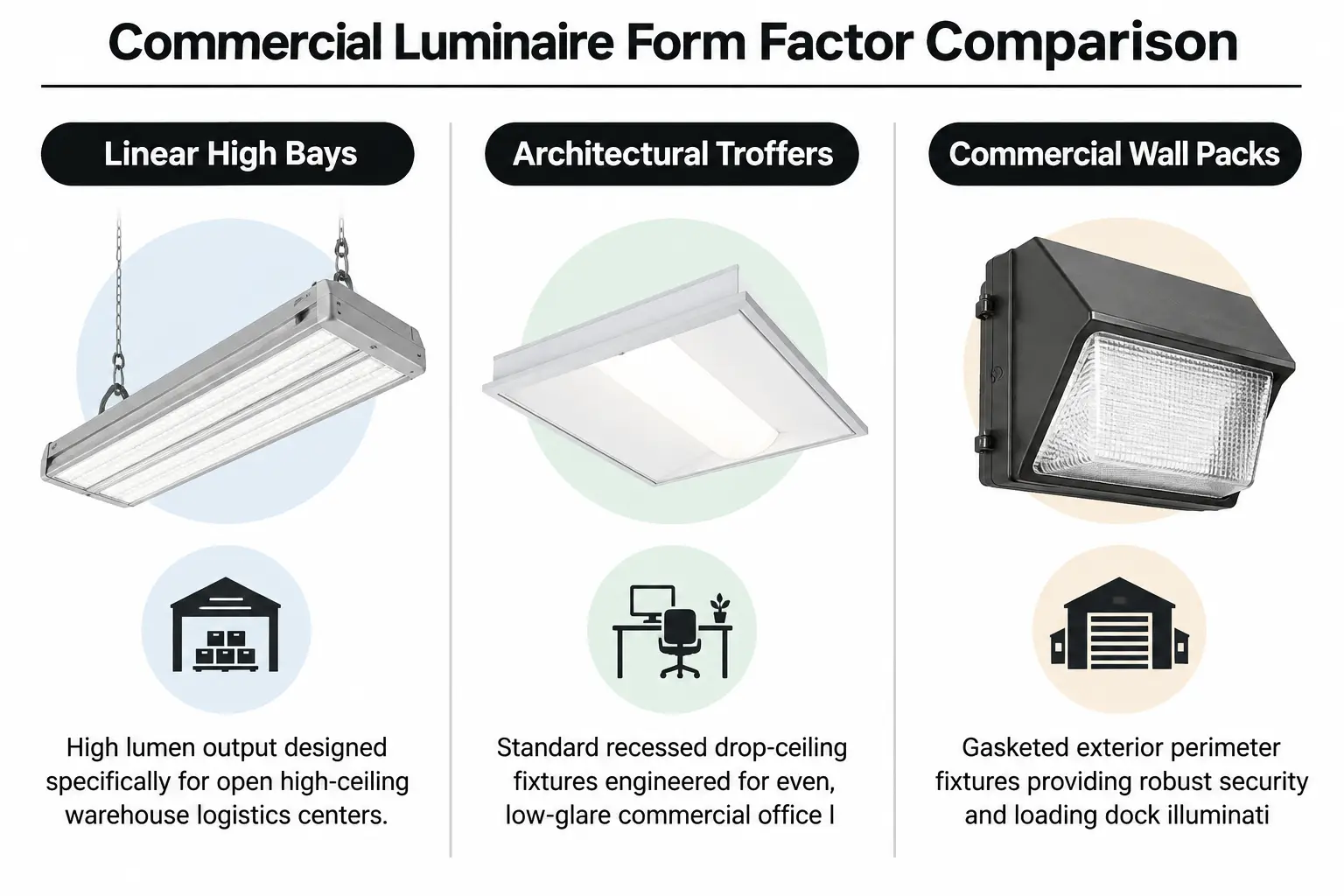
| Fixture type | Best application | Financial strengths | Operating limits |
|---|---|---|---|
| Linear high bays | Warehouses and industrial logistics centers | 150W units replace 400W metal halides, sharply reducing energy use at each socket | Needs precise beam control to prevent glare along active forklift routes |
| Architectural troffers | Corporate offices, educational sites, and retail suites | Standard ceiling-grid fit keeps installation labor under fifteen minutes per fixture | Fits drop-ceiling grids only, unless surface-mount kits are added |
| Architectural linear extrusions | Design studios, executive corridors, and boutique hospitality | Finished appearance with rigid aluminum housings for continuous runs | Costs more upfront than standard commercial troffers |
| Commercial wall packs | Loading docks, building perimeters, and yard access points | Powder-coated enclosures resist vandalism and coastal moisture | Needs built-in photocells to keep lights from burning during daylight |
Our guide to industrial LED fixtures for LA warehouses helps you choose drivers that withstand sudden electrical spikes. In modern architectural spaces, specialized LED channels spread light evenly along a line, without visible dots from individual LEDs.
Calculating Fixture Counts and Lumen Distribution for Maximum Efficiency
Order quantities should come from target foot-candles, a measure of light reaching a surface, rather than one-for-one replacements. LEDs direct light where it is needed. You can often use fewer fixtures than with older fluorescent or high-intensity discharge (HID) systems that shine in all directions. Electrical contractors can plan the layout in five steps:
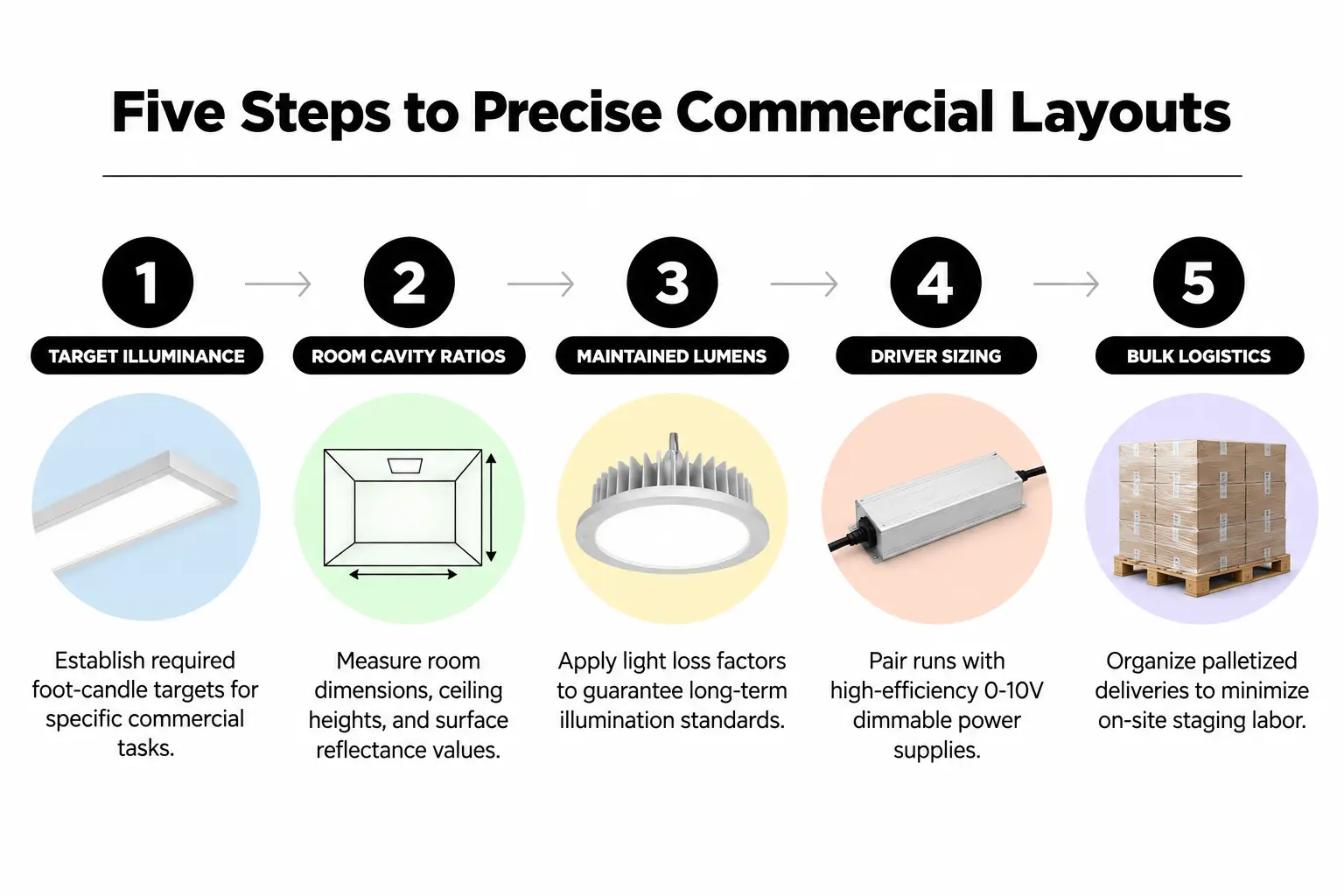
- Set target light levels: Use standard Illuminating Engineering Society benchmarks to establish the foot-candles needed for the work done in each space.
- Measure the room: Record ceiling height, work-surface height, and room dimensions. These measurements help determine how light reflects from walls and floors.
- Allow for light loss: Calculate maintained lumens, the light output expected as fixtures age. The system must provide enough light throughout its rated life.
- Size the power supplies: Match fixture runs with efficient LED drivers. Keep power factor, a measure of effective electrical use, above 0.90 to avoid power-quality penalties.
- Plan bulk packaging: Work out how the order will ship on pallets to reduce unboxing labor and avoid waste during job-site staging.
For bulk LED orders, work directly with a lighting supplier who can model light distribution on a computer before you issue a purchase order. These photometric calculations show where the light will land. Accurate layouts prevent costly over-ordering and keep dark corners from putting workers at risk.
Navigating Title 24 Mandates and Los Angeles Permitting Standards
California commercial lighting retrofits must meet strict energy codes. The California Energy Commission enforces these rules through its building energy efficiency standards, known as Title 24. Across commercial spaces, the rules limit lighting power density (LPD), the total lighting watts used per square foot.
In Los Angeles, permitted work generally triggers mandatory controls when more than ten percent of fixtures in an enclosed space change. Fixtures must support 0-10V dimming, daylight-based adjustment, and automatic occupancy sensing. Equipment qualified by the DesignLights Consortium qualifies for local utility rebate incentives, which can substantially reduce upfront hardware costs.
Code check: Verify that replacement fixtures meet Title 24 automatic multi-level dimming thresholds before you finalize the fixture schedule. Non-compliant fixtures will hold up your final building inspection.
A qualified local LED lighting wholesaler makes this work simpler by carrying commercial product lines already checked against California standards. Unsure about the city’s plan-check requirements? You can reach our technical desk to review specification sheets before submitting them.
Accounting for Maintenance Cycles, Operating Hours, and True Payback
A full return-on-investment calculation includes energy savings plus avoided maintenance costs for parts and labor. Fluorescent ballasts and HID lamps need recurring service every two to three years. Commercial LED fixtures, by comparison, routinely provide 50,000 to 100,000 hours of continuous service before their light output drops by thirty percent.
Video: Calculating a ROI for LED Retrofits in Casinos (Peaks To Prairies Pollution Prevention Information Center)
Use this baseline equation to find how long the project takes to pay for itself:
Payback formula: Simple payback (years) = net installed project cost / (annual kWh reduction × blended kWh rate + annual avoided labor and replacement costs).
Industrial upgrades in Southern California facilities with long operating hours routinely recover their full cost in 14 to 22 months. Compare the cost to upgrade commercial lighting now with the cost of waiting. Each month you delay means paying utility costs the new fixtures would have avoided.
Procurement Audit Checklist Before Placing Commercial Orders
Before sending a purchase order, check your materials list against the building’s electrical and mounting requirements:
- Input voltage range: Check that fixtures match the existing branch circuits. Distinguish between universal 120-277V equipment and fixtures for dedicated 480V industrial lines.
- Enclosure ratings: Check damp- or wet-location requirements for covered docks and transition areas. Identify which fixtures carry a wet rating before installation starts.
- Driver dimming compatibility: Identify how the existing controls work: line-voltage phase cutting, low-voltage 0-10V wiring, or digital multiplexing, which sends control signals digitally.
- Color temperature consistency: Set matching Kelvin targets, the measure of light’s warm or cool appearance, across continuous ceilings so adjacent rooms do not clash.
- Mounting accessories: Make sure the first shipment includes the needed aircraft cables, pendant stems, or surface-mount flanges rather than ordering them later.
- Local stock: Verify that your distributor holds inventory locally. Split shipments can delay the job and drive up the contractor’s labor costs.
Practical Answers on Commercial LED Payback in Los Angeles
How quickly does a typical commercial LED retrofit pay for itself in Los Angeles?
Most commercial retrofits pay for themselves within 12 to 24 months, depending on operating hours and utility rates. Distribution warehouses and 24-hour retail centers often get there faster with municipal utility rebates. Avoiding maintenance labor at high ceilings also makes a substantial difference to the payback period.
Can I mix different color temperatures across an open commercial floor plan?
Keep color temperatures consistent across an open space so the lighting looks intentional and cohesive. Mixing them is acceptable only between separate functional zones, such as private offices and open work areas. Even there, place the change at a wall or another architectural boundary rather than midway across a room.
Do I have to pull electrical permits for a commercial one-for-one fixture replacement?
Los Angeles Department of Building and Safety guidelines require permits for commercial lighting changes that alter circuit wiring or exceed Title 24 thresholds. Simple lamp-for-lamp bypass work may fall below those triggers. Full fixture replacements typically need plan review to show that the lighting meets mandatory power-density limits.
What makes commercial fixtures last longer than residential lighting products?
Commercial fixtures use heavy extruded aluminum housings to move heat away from sensitive LEDs and internal driver capacitors. Their commercial-grade drivers also withstand incoming power spikes without failing early. Those industrial components keep fixtures at their rated light output across decades of continuous commercial use.
Are surface mount disk fixtures suitable for commercial corridor retrofits?
Yes, a commercial-grade LED disk is an economical option that sits flush against the ceiling. It fits directly onto a standard junction box without needing deep openings into the space above. These fixtures sharply reduce installation time and give hospitality and multifamily corridors a clean appearance.
Partnering with Raycos Lighting on Your Next Capital Upgrade
Based locally, Raycos Lighting serves commercial developers, general contractors, and facility managers across the Los Angeles region. We keep deep local inventory and focus on getting fixtures delivered to match your project schedule. Our commercial range includes high bays and architectural troffers, along with LED linear tapes for specialized installations.
Before materials ship, our team reviews lighting schedules and contractor counts to verify code compliance. For a fixture review, a photometric layout, or wholesale contractor pricing, contact our team for immediate technical support.