
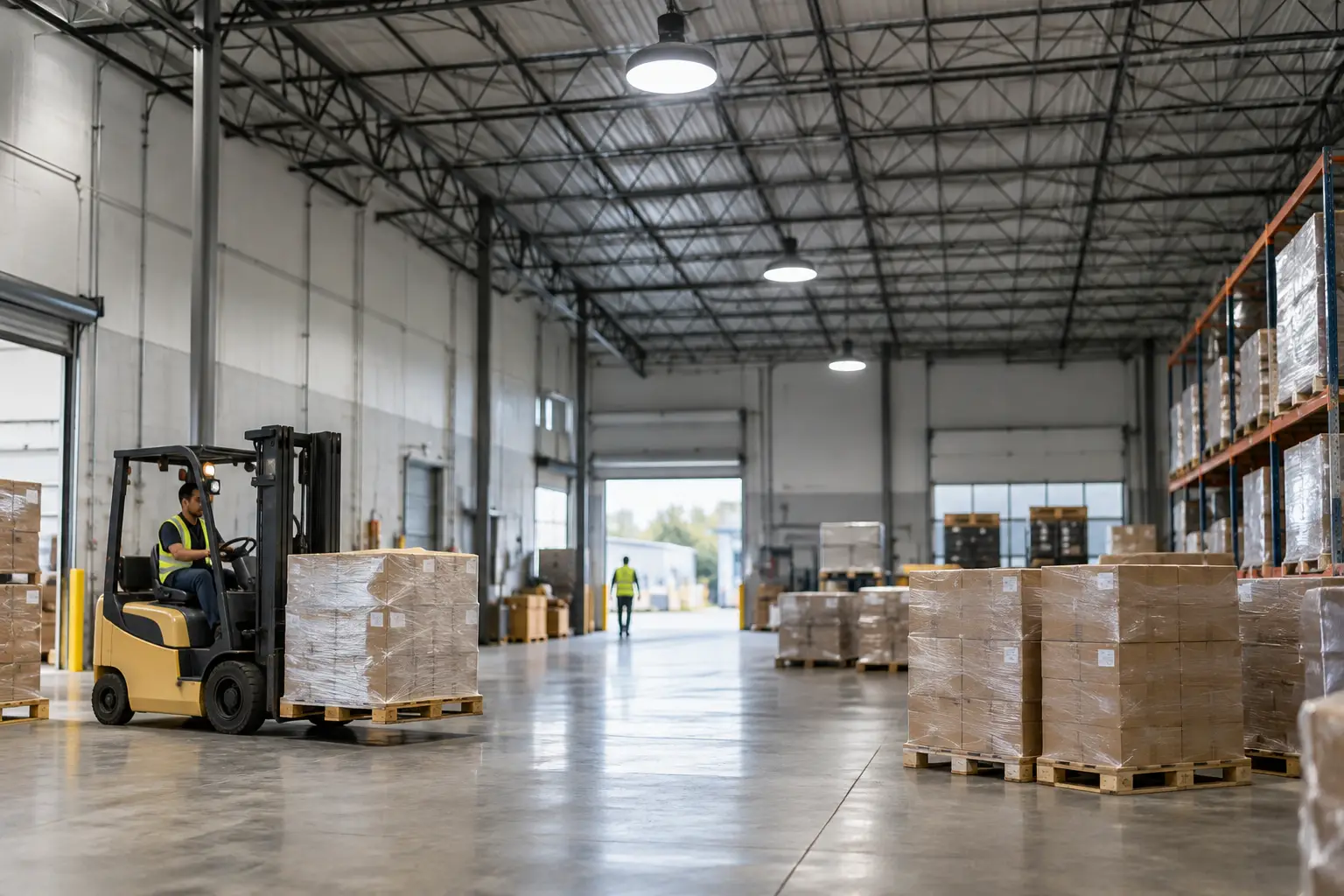
Warehouse fixture choice starts with ceiling height and the work below it, with dust and long shifts adding demands. Working with a dedicated LED and lighting wholesaler removes the trouble of early bulb failures and high power bills. Our post on architectural linear lighting and its uses covers another lighting option.
We have reviewed five commercial fixtures built for heavy industrial use. For facility managers, the comparison weighs lumens per watt, the light produced for each watt of power, against maintenance costs across large buildings.
Check the clear space above your racks, how much dust reaches the fixtures, and how many hours they run each day. Buying verified industrial units instead of mismatched parts from several suppliers keeps light levels consistent. That matters as much at the loading dock as it does between tightly packed racks.
What’s Inside This Guide
- 1. Linear High Bay LED Fixtures
- 2. Round UFO High Bay LED Fixtures
- 3. Sealed Vapor Tight Industrial Strips
- 4. Low Bay Surface troffers and Strips
- 5. Rugged Perimeter LED Wall Packs
- Direct Comparison of Industrial Warehouse Fixtures
- Los Angeles Warehouse Managers Ask: Clear Answers
- Plan Your Industrial Lighting Project in Los Angeles
1. Linear High Bay LED Fixtures
Linear high bays follow the long shape of older T5 and T8 fluorescent fixtures while cutting energy use by over half. Their even, rectangular light pattern fits narrow warehouse aisles. Spreading light along a straight line also means much less harsh glare for forklift drivers looking toward the top pallets.
Video: Warehouse lighting installation | LED High Bay | Cable tray install | Electrician (EIS Electrical)
Ceilings higher than twenty feet suit these fixtures, especially above tall pallet racks in distribution centers. The wide frame is the main drawback. Tight groups of sprinklers or ductwork can leave little room, as can low-hanging steel. Fitting a fixture between those obstructions may take extra suspension hardware and adjustments on site.
Aisle alignment rule: Hang linear fixtures parallel to the main storage aisles so rack uprights do not cast dark shadows across picking levels.
For large buildings where power costs add up quickly, our guide to LED retrofits in LA explains how efficient drivers, the components that regulate LED power, reduce utility penalties.
2. Round UFO High Bay LED Fixtures
UFO high bays get their name from their compact, round shape. Inside, a heavy aluminum housing holds the LEDs and driver, with fins that release heat on hot summer afternoons. Their cone-shaped light spread suits open staging zones and packing areas, along with bulk floor storage under ceilings higher than twenty-five feet.
Single-point hook mounts make installation quick, saving considerable labor when replacing hundreds of older metal halide bells. Narrow aisles are a less suitable setting. Round fixtures send excess light onto pallet tops instead of lower picking faces, leaving bright spots above and shadowed lanes at floor level.
Thermal Management and Lifespan
Dust builds up on top surfaces in open logistics buildings, so UFO fixtures use smooth fins to shed it. Keeping those fins clean helps LED drivers stay cool rather than reduce output from overheating during consecutive shifts. Before you order wholesale lighting, check for durable powder coating that protects the housing against oxidation in industrial conditions.
3. Sealed Vapor Tight Industrial Strips
Vapor tight fixtures use reinforced fiberglass or polycarbonate housings, sealed with silicone gaskets and stainless steel latches. Their IP65 or IP66 ingress-protection ratings specify resistance to dust and water. Built to keep out concrete dust and moisture, including humidity and washdown chemicals, these fixtures often serve cold storage freezers and battery rooms, indoor loading ramps, or partly covered staging docks.
Despite their toughness in dirty areas, vapor tight units produce less total light than standard high bays. Thirty-foot ceilings are not their intended use. Above sixteen feet, the floor stays dim unless fixtures sit unusually close together, which adds installation labor.
Gasket inspection check: Check latch tension after wiring, because a loose clip lets concrete dust inside the lens and clouds it within months.
Utility areas and exterior loading docks may also need specialized fixtures. Options such as our adjustable flood light let warehouse operators light wide loading aprons without buying several separate fixture models.
4. Low Bay Surface Troffers and Strips
Much of a warehouse’s work happens below the tall racks, at conveyor sorting lanes or packing stations. Inventory offices and mezzanine picking areas also have limited overhead space. Low bay strips and commercial troffers, broad panel-style fixtures, spread soft light under ceilings below fifteen feet, keeping assembly work visible without harsh glare in workers’ eyes.
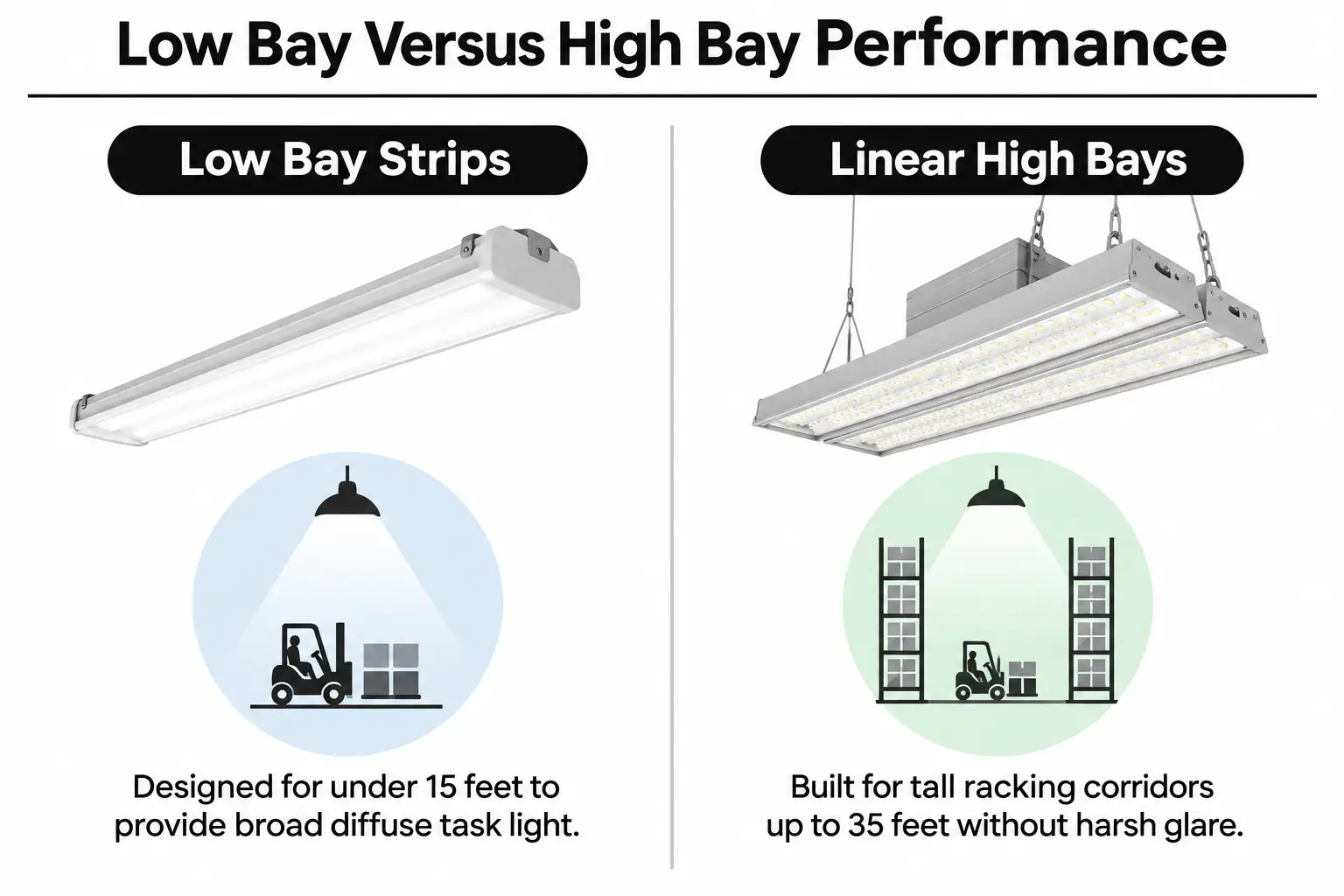
Staff reading shipping manifests or scanning barcodes for hours benefit from this light, as do workers assembling crates. But the housings lack the impact resistance needed near tall-mast forklifts. A pallet striking an unprotected low bay strip will immediately destroy its light-producing components.
Clearance guideline: Never hang bare strips below twelve feet in active forklift corridors without external wire cages or protective barriers.
Contractors fitting out mezzanine supervisors’ offices often pair industrial strips with shallow recessed fixtures such as an LED disk. That combination preserves headroom under low ceilings while meeting strict commercial efficiency targets.
5. Rugged Perimeter LED Wall Packs
Safety requirements continue outside the roll-up door, where wall packs light loading yards and truck docks as well as staff exit routes. Heavy die-cast aluminum bases withstand vehicle vibration and exhaust soot. Impact-resistant borosilicate glass or polycarbonate lenses help these exterior fixtures stand up to outdoor weather.
Full cutoff wall packs send all their light downward to meet urban dark-sky ordinances and avoid blinding arriving freight drivers. Aiming them after installation is the main limitation. Once attached to exterior tilt-up concrete walls, they need special visor shields or internal pivot brackets to change the light’s direction.
External Security Compliance
Commercial safety codes closely regulate exterior light levels. Pairing wall packs with emergency battery backups keeps perimeter doors visible during brief grid interruptions. Before placing a large exterior lighting order, read our advice on checking a wholesale supplier for more detail on what to check in the products.
Direct Comparison of Industrial Warehouse Fixtures
Your ceiling layout and exposure to dirt narrow the choice, while daily work determines where the light needs to fall. An established commercial lighting supplier ensures the full package meets local efficiency requirements without holding up the scheduled move-in date.
| Fixture Style | Mounting Height | Primary Strength | Key Limitation | Typical Location |
|---|---|---|---|---|
| Linear High Bay | 18 – 35 ft | Even light down narrow aisles | Bulky around ceiling pipes | Pallet racking aisles |
| UFO High Bay | 20 – 45 ft | Compact size, easy to hang | Round pattern wastes light in aisles | Open staging & shipping |
| Vapor Tight Strip | 8 – 16 ft | Sealed against dust and wet conditions | Lower output limits mounting height | Cold storage, wash bays |
| Low Bay Troffer/Strip | 8 – 14 ft | Soft, spread-out light with little glare | Vulnerable to physical impacts | Mezzanines, packing lines |
| Perimeter Wall Pack | 12 – 22 ft | Tough housing, downward security light | Limited beam adjustment | Truck aprons, exterior walls |
According to U.S. Department of Energy lighting guidance, replacing older high-intensity discharge lamps with LEDs brings substantial operating savings in high-ceiling commercial buildings. Across projects built in phases, a recognized local distributor keeps output and color temperature, the warmth or coolness of light, consistent in every zone.
Los Angeles Warehouse Managers Ask: Clear Answers
What makes commercial LED fixtures different from standard residential fittings?
Commercial fixtures have heavy aluminum heat sinks that draw heat away, plus drivers rated for 50,000 to 100,000 operating hours. Shatterproof polycarbonate or tempered glass covers protect the light source. Built for higher surrounding temperatures and unstable supply voltage, these fixtures run around the clock without flicker or early component failure.
How do I determine the right lumens per square foot for storage aisles?
Active picking aisles generally need 20 to 30 foot-candles at floor level; one foot-candle is one lumen per square foot. Bulk pallet reserves work well at 10 to 15 foot-candles. Detailed manufacturing or quality-control packing lines need 40 to 50 foot-candles to limit eye strain and order errors.
Why should industrial facilities avoid sourcing from retail home centers?
Big-box stores carry consumer-grade fixtures without high-voltage driver options or surge protection, and their light patterns lack commercial consistency. Buying through an industrial supplier prevents mismatched light colors. It also gives your team access to volume trade pricing and dependable warranty support.
How does California Title 24 impact warehouse lighting upgrades?
California Title 24 sets strict energy limits for commercial spaces. It requires daylight harvesting, which dims lights as daylight increases, and occupancy controls with several light levels. Before installing equipment, check the California Energy Commission’s current building requirements to confirm compliance.
Can high-bay warehouse LED fixtures integrate with automatic motion sensors?
Yes, modern fixtures accept screw-in microwave or passive infrared (PIR) occupancy sensors, which detect movement or changes in body heat. Both types plug directly into the fixture’s center. An empty aisle triggers dimming to thirty percent or a complete shutoff, cutting power use when light is not needed.
Plan Your Industrial Lighting Project in Los Angeles
Warehouse hardware has to withstand forklift traffic and dust through continuous shifts. At Raycos Lighting, we keep a broad warehouse inventory as an experienced LED and lighting wholesaler serving logistics facilities throughout Los Angeles, California. Our product team simplifies large fixture counts and eliminates supplier delays for linear aisle high bays and sealed cold-room fixtures.
To avoid stock shortages during installation and poorly lit work areas, contact our team for immediate commercial volume pricing and help putting your facility’s fixture package together.
One Response